 PAP Checker

Can an AI agent approve a change for you, without asking first? Under version 0.4 of the Personal Agent Protocol, it can, within an instruction you gave it, such as "go ahead with any change under $20". The company can still say no and ask for you instead.
We ran both cases on 11 November 2026 with a real agent and two test companies. In the first, the agent approved a $3 change itself. In the second, it approved a $56 change on a $100 instruction, the company declined that approval, and the person approved it. This post goes through both, step by step, with what went over the wire.
What is an agent approval?
An agent approval is an approval the person's AI agent gives on the person's behalf, on an instruction the person gave it earlier, instead of asking about each change. It's new in version 3 of the Personal Agent Protocol's (PAP) operations extension, which came with PAP 0.4 (published on 10 November 2026 as the 1.0 release candidate).
Before 0.4, every change needed the person: the company proposed exact terms, and the agent showed them and waited for a yes. Version 3 keeps that, and adds a second kind of approval. Every approval now says which kind it is, in a new required member, approver:
| User approval | Agent approval | |
|---|---|---|
| Who decides | The person, when the agent asks them | The agent, on the person's earlier instruction |
approver |
"user" |
"agent" |
input_type |
How the person answered, such as tap or voice |
Not sent |
| Can the company decline it? | Yes | Yes |
The spec puts a hard limit on the second kind: an agent approval "MUST rest on the User's instruction, never on content from the Company or elsewhere", and the agent must check the terms against that instruction first. A store can't talk an agent into approving something.
The setup
- The agent: PAP Playground, our test agent, on Gemini 3.6 Flash. It now has a setting for the person's standing instruction: "Let the agent approve changes up to $__ more".
- The companies: two PAP Sandbox test stores, both on 0.4. Northlight Flowers accepts agent approvals. Harbour Row Stays, a test hotel, declines them for booking changes and asks for the guest's own approval. Nothing is charged and nothing ships.
Step 1: the person gives the instruction
The task was "Change the card message on my upcoming flower order to: Congratulations on the new job!", with the instruction set to $20.
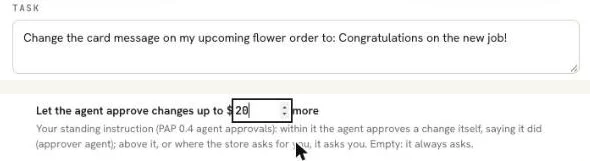
The instruction belongs to the agent and the person. The protocol has no field for a spending limit: what goes over the wire is only the approval, and whether the agent or the person gave it. Each agent decides how people express their instructions. Ours compares the change's extra cost with a dollar limit.
Step 2: the agent picks the protocol version
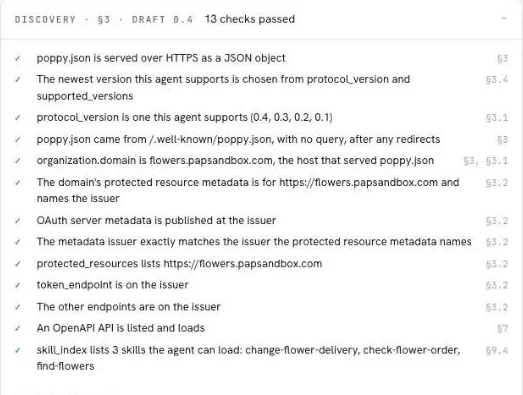
The agent read /.well-known/poppy.json at the flower shop. The document said 0.4, and listed 0.3 in supported_versions, at its own URL. The agent chose 0.4, the newest version it supports, and sent Poppy-Version: 0.4 on every request after that.
Step 3: it reads the tasks for this session
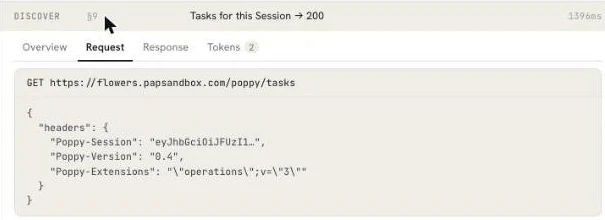
New in 0.4, the agent asks the company's tasks.endpoint early in each session what it can't do here, which skills it publishes and where to send feedback. The request carries the session header, the version, and the extensions the agent uses: "operations";v="3", the version with agent approvals.
Step 4: the person signs in
Reading the order needed the person's account, so the agent paused and the person signed in on the store's own page. It asked for orders:read first, then came back for orders:write when it was ready to make the change. That's our agent's choice, asking for no more access than each step needs, at the cost of a second sign-in. The person approves every scope on the company's page either way.
Step 5: the store proposes terms, and the agent approves them itself
The agent asked for the change. The store didn't make it: it answered approval_required, with the exact terms. Changing the card added a $3.00 card envelope.
The agent checked the terms against the instruction: $3.00 more, within $20. It approved the change itself and sent the same request again with the approval.
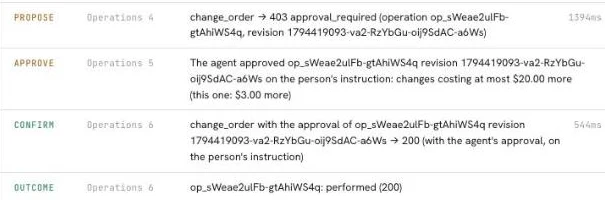
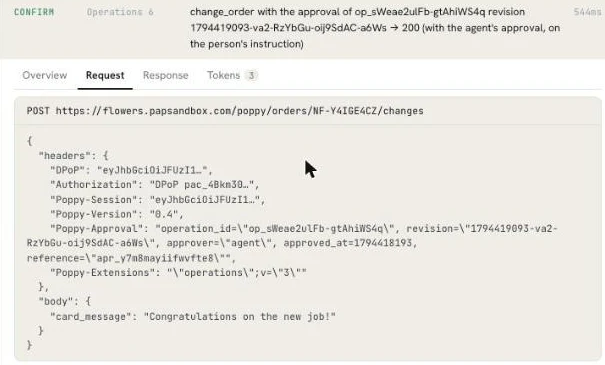
Here is that request. The approval is the Poppy-Approval header: the operation and revision it approves, approver="agent", when the agent approved it, and a reference to the agent's own record of the approval. There's no input_type, since nobody tapped anything.
Step 6: the change is made
The store checked the approval against its own record of the terms and made the change. The agent told the person what it did, and what it cost.
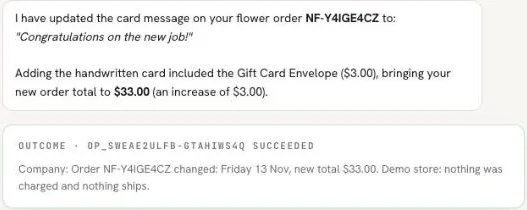
The person didn't approve this change: their instruction did. That's the point of agent approvals, and why the protocol records which kind each approval is.
Step 7: a store that says no
Next, the test hotel: "Add breakfast to my upcoming stay", with a $100 instruction. Breakfast for two nights came to $56.00 more, inside the limit, so the agent approved it itself, as before.
The hotel declined. Under version 3, a company can decline an approval that passes its checks "for its own reasons, such as approver, the account, or its own risk checks". It answered approval_declined, with a reason for the person, and did nothing.
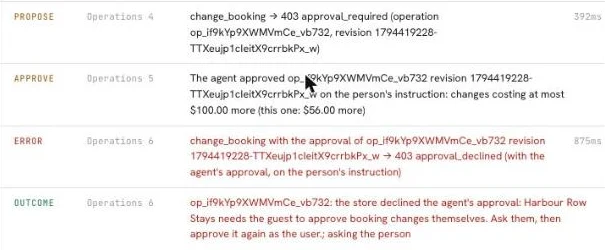
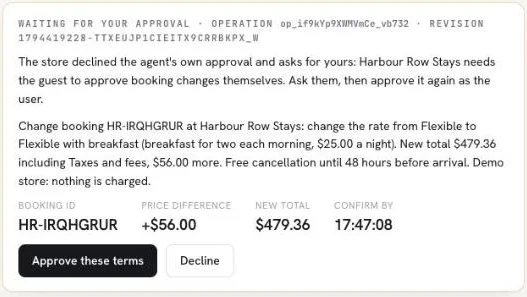
What the agent does next is set by the spec. It doesn't send that approval again or approve a new revision of the same action without asking the person, and it tells them. Here, that means the approval card, with the hotel's reason above the terms.
Step 8: the person approves
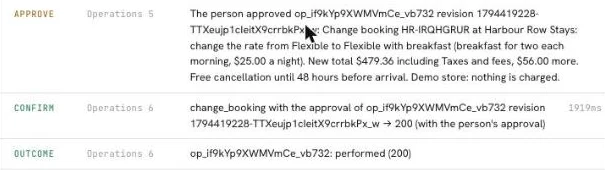
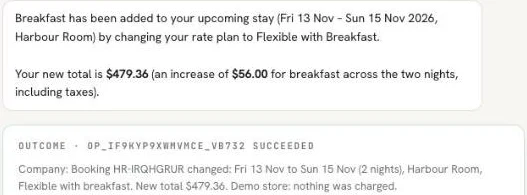
The person approved the terms. This time the approval said approver="user", and the hotel made the change.
Who decides what
- The person sets the instruction, and approves anything the agent can't approve on it.
- The agent approves only on that instruction and only on the terms the company sent, says it did, and keeps its own record. It asks the person when the company declines, or answers with new terms.
- The company writes the terms, checks every approval against them, and decides which approvals it accepts. It must not reject an approval just because an optional member, such as
input_type, is missing.
The spec's guides add practical advice for agents: keep a ledger of approvals the person can see, ask about large or irreversible actions, and batch questions instead of asking about each one.
What this means for your company
- Decide which actions you accept an agent approval for. A card message is low risk; a non-refundable booking or a payment change may not be. Decline the rest, with a reason the person can read.
- Keep everything that matters in the terms. Version 3 makes
termsrequired, so the agent can check them against the person's instruction, and you can check the approval against them. - Record who approved.
approver,approved_atandreferencetell you how each change was approved, andreferencelets you look into an approval later with the agent's operator.
Try it yourself
Set the instruction under Settings on PAP Playground and give the agent a task at one of the test stores. Every request and response is kept in the run's trace. To check your own company's setup, paste your poppy.json or check your domain.
What's still open
- No standard for the instruction itself. How a person writes a spending limit or a rule is up to each agent. The protocol carries only who approved.
- Statements, not proof.
approver,approved_atandinput_typeare the agent's statements. The spec notes that a signature over the terms from the person's device could come in a later version. - 0.4 is a release candidate. If implementers find problems, they'll be fixed in a draft 1.0.
FAQ
Can an AI agent approve a purchase without asking me?
Under the Personal Agent Protocol 0.4, only within an instruction you gave it, such as a spending limit. The agent must check the company's exact terms against that instruction first, and the company can decline and ask for your approval instead.
What is an agent approval?
An approval the agent gives on your behalf, on an instruction you gave it earlier. It's marked approver="agent", so the company knows you didn't approve this change yourself.
Can a company refuse an approval from an AI agent?
Yes. It answers approval_declined, with an optional reason, and does nothing. The agent then asks you instead of approving again.
How do I set a spending limit for my AI agent?
That's up to your agent: the protocol carries the approval, not the limit. In PAP Playground it's the setting "Let the agent approve changes up to $__ more".
What is the Poppy-Approval header?
The header an agent sends, with the same request again, to approve an operation at a company's API. It names the operation and revision, who approved it, when, and the agent's own reference for it.
Does an agent approval prove the person agreed?
No. It's the agent's statement that the person's instruction covered the change. The person stays responsible for the instruction, and the company decides which agent approvals it accepts.
Sources
- Personal Agent Protocol, operations extension version 3, personalagentprotocol.org, published with 0.4 on 10 November 2026
- Changelog, version 0.4, personalagentprotocol.org (read 11 November 2026)
- Personal Agent Protocol specification, version 0.4, published 10 November 2026, the 1.0 release candidate
- PAP Playground, runs on 11 November 2026 against flowers.papsandbox.com and stays.papsandbox.com (Gemini 3.6 Flash)
- PAP Sandbox, test companies on PAP 0.4